Mountain Living · April 2026 · 8 min read
Mountain Living: The Allure of Blue Ridge Luxury Estates
The Blue Ridge Mountains offer a form of luxury that cannot be manufactured — elevation, solitude, and a landscape that shifts with every season. For those who understand its appeal, mountain living represents the ultimate retreat.
There is a category of luxury buyer for whom the coast holds no particular fascination and the suburban estate, however grand, feels insufficient. These are buyers drawn to elevation — to the drama of long-range mountain views, the privacy of ridgeline siting, and the sensory richness of a landscape that transforms itself across four distinct seasons. The Blue Ridge Mountains of western North Carolina have quietly become one of the most compelling luxury markets in the Southeast.
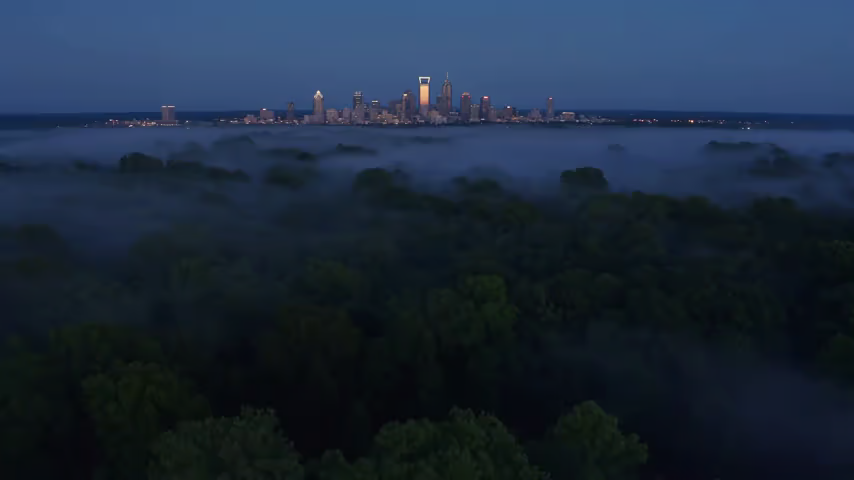
The appeal begins with the land itself. Properties at elevation — 3,000 feet and above — occupy a fundamentally different climate zone than the Carolina Piedmont. Summer temperatures rarely exceed the mid-eighties. Morning fog fills the valleys below while ridgeline estates sit in brilliant sunshine. Autumn brings a color palette that no designed landscape can replicate. Winter offers a stark, contemplative beauty that rewards those willing to embrace the season.
Architecturally, the finest mountain estates honor their setting rather than competing with it. The most successful designs employ natural stone, reclaimed timber, and expansive glass to create homes that appear to emerge from the mountainside. Great rooms with cathedral ceilings frame panoramic views. Covered terraces and outdoor living spaces — often with stone fireplaces and heated floors — extend the habitable season deep into autumn and early spring.
Communities such as The Cliffs at Walnut Cove, Balsam Mountain Preserve, and Champion Hills have established the standard for curated mountain living. These developments offer golf, wellness facilities, hiking trails, and farm-to-table dining within gated, architecturally controlled environments. Yet some of the most extraordinary mountain properties exist beyond community gates — independent estates on 20, 50, or 100-plus acre parcels where privacy is absolute and the landscape is uninterrupted.
The practical considerations of mountain ownership deserve frank discussion. Access roads, water sourcing, septic engineering, and construction logistics at elevation add complexity and cost. Homes must be designed for freeze-thaw cycles, high winds, and the particular demands of steep-slope building. Builders with genuine mountain experience — firms that understand soil conditions, drainage patterns, and the structural requirements of cantilever construction over dramatic terrain — are essential partners.
For the right buyer, a Blue Ridge mountain estate offers something that no urban penthouse or lakefront manor can provide: the experience of living within a landscape of genuine grandeur, where the horizon extends for fifty miles and the nearest neighbor may be beyond the next ridge. It is a form of luxury defined not by proximity to amenity but by distance from everything ordinary.